Numerous degrees of freedom complicate the selection process
by Ron Stephens, Senior Sales Executive at Q-Tech Corporation
This article provides a comprehensive overview of the key performance parameters that must be considered when selecting the optimal quartz crystal oscillator for a space application. Regardless of the orbit and the application, there are numerous degrees of freedom that will complicate the selection process. The goal of engineering design is to select the most cost-effective part that meets the physical constraints and performance metrics required for the application.
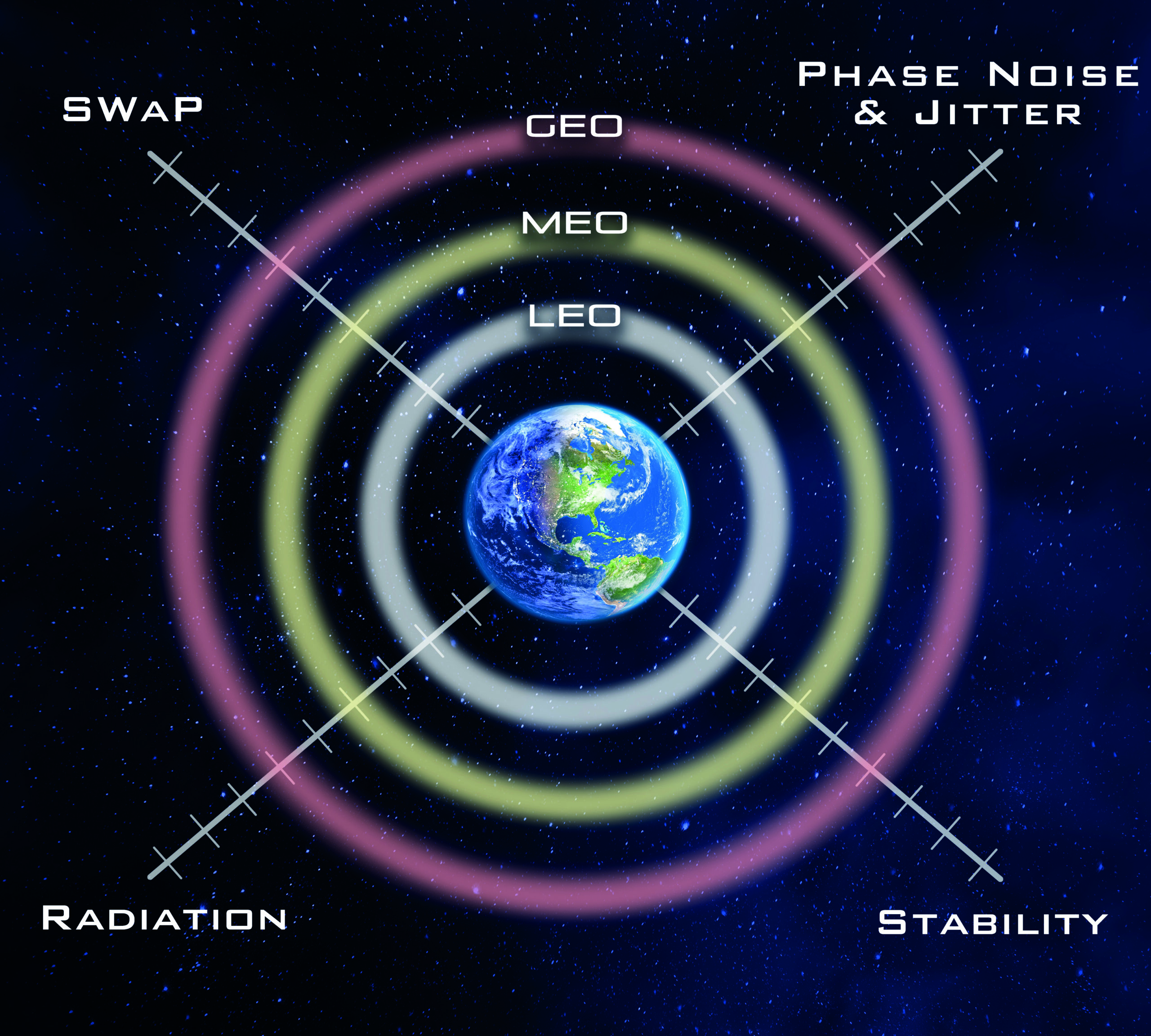
Manufacturers of space-qualified crystal oscillators, like Q-Tech, have developed a range of devices—XOs (crystal oscillators), MCXOs (microcomputer-compensated XOs), TCXOs (temperature-compensated XOs), VCXOs (voltage-controlled XOs), OCXOs (oven-controlled XOs), and SAWs (surface acoustic wave oscillators)—to provide optimized price and performance for orbital applications from low Earth orbit to geosynchronous orbit and beyond. The key parameters affecting the proper selection are:
• Radiation Hardness
• Stability
• Phase Noise and Jitter
• Size, Weight, and Power (SWaP)
Radiation hardness (TID and SEE)
Solar ionizing radiation exposure increases with altitude and the resulting reduction in the atmosphere’s ability to absorb/reflect its effects. Ionizing radiation does not have an intrinsic effect on a quartz crystal. However, quartz crystal oscillators are hybrid devices that combine the crystal with semiconductor devices and other components. Semiconductors are susceptible to degradation due to the ionizing effects of solar energetic particle events typically caused by solar flares.
The ability of a device to provide the expected performance and longevity of operation is determined by its ability to withstand a lifetime total ionizing dose (TID), which is measured in krad(Si). The deeper into space, the higher the TID requirement.
In addition to TID, some applications require devices to be tested for performance when subjected to spurious events, such as cosmic rays or high-energy protons that can induce device latch-up or other functional interruptions, referred to as single-event effects (SEEs). The primary concern is single-event latch-up (SEL), which can lead to a catastrophic and non-recoverable system condition. Although SEE testing can be time-consuming and expensive, it is necessary in many high-reliability applications.
Stability
A stable frequency is of great importance in applications where the oscillator is used for navigation, communications, and other precise timing functions. The required degree of stability, expressed in parts per million (ppm) or parts per billion (ppb), will depend on both the precision of the function and the expected mission life of the system.
• MCXOs, OCXOs: High-end stability (ppb)
• TCXOs: Excellent stability, ±1 to ±4ppm
• Full Space XOs, New Space: ±50 to ±100ppm
• VCSOs: ±200 to ±50ppm is the standard stability up to 1.3 GHz
Temperature stability is another key parameter. Operating temperature variations grow wider as the distance from the Earth’s surface increases. LEO satellites experience a wide range of temperatures
from –170 to +123°C as they encircle the planet, alternating between full exposure to the sun and total darkness. MEO and GEO satellites can experience external temperatures from –250 to +300°C. All satellites feature thermal management to maintain an operating temperature within a narrow range of –55 to +85°C.
In addition to stability over-temperature performance, aging is important for long-life missions, as shown, in order, starting with the best:
OCXOs, MCXOs: ±1.5ppm max over 15+ years
TCXOs: ±4ppm max over 15+ years
XOs: ±5ppm max per year
Q-Tech’s space-qualified QT2020/QT2021 MCXO offers ppb stability rivaling the performance of OCXOs, but with less size, weight, and power (<90 mW vs. multiple watts for the OCXO).
Phase noise and jitter
As with stability, phase noise and jitter will vary depending on the device topology. In general, the hierarchy of performance is as follows:
• OCXOs: Best in Industry
• MCXOs: Best in Industry
• TCXOs: Excellent
• XOs: Good, but beaten by oscillators above
• SAWs: Very good noise floor, but close-in noise is beaten out by other types of oscillators
Size, weight, and power (SWaP)
Until recently, it could be said that a decreasing SWaP “figure of merit” would apply for satellites deployed in more distant orbits with longer expected lifetimes. However, with the advent of “new space” low Earth orbit (LEO) constellations comprising hundreds, and possibly thousands, of smaller satellites, optimizing SWaP has become nearly a universal objective.
Smaller and lighter devices are often required as designers pack more functions into shrinking payloads. But the size of the package will also depend on other factors, such as stability and temperature. Package sizes typically fall into the following ranges, by type. And weight is directly related to size:
• MCXOs: 2 x 1 x 0.33 in
• OCXOs: (by far the largest) – 2 x 2.5 x 1.5 in
• TCXOs: (larger than standard XO Hybrids) 1 x 1 x 0.2 in
• Space XOs: Ceramic packages as small as 5 x 7mm
• SAWs: 0.625 x 0.625in (flat pack)
• Ultra-Miniature XOs (for new space): Ceramic SMDs as small as 3.2 x 5 mm
As would be expected, devices with temperature compensation or oven-control circuitry will require more power than a basic XO package:
• MCXOs: < 90mW
• OCXOs: 2.7W at room temperature, 4.8W at –40°C
• TCXOs: 55 to 80mA
• Space XOs: 10 to 50mA
• New Space XOs: 2.5mA to ~40mA
Conclusion
Ultimately, finding the proper quartz crystal oscillators for space applications will rely on cooperation between the design engineer and the vendor. The manufacturer should offer a wide range of devices, each optimized to meet the specific parameters of radiation hardness, stability, phase noise, jitter, and SWaP. Q-Tech, for example, has developed the largest selection of space-qualified parts available today—from TCXOs and OCXOs to MCXOs—with the industry’s best SWaP. Furthermore, Q-Tech has been providing expertise in device selection for over 40 years, longer than any other supplier, and offers more space-qualified parts than any of its competitors.
www.q-tech.com