By Shashank Bangalore Lakshman, Graduate Researcher at the University of Texas at Austin
When we watch modern agentic AI agents browse the internet, execute code, or manage complex workflows, it’s easy to believe we are witnessing a spark of digital sentience. High-level frameworks have wrapped AI in layers of abstraction that make it feel like absolute magic.
I decided to strip away those libraries and build an agent from first principles. By developing a minimally viable autonomous agent built entirely from scratch in just 450 lines of simple Python code, I can show how AI agents aren’t magical or sentient entities. Rather, they are deeply deterministic programming loops interacting with probabilistic language models.
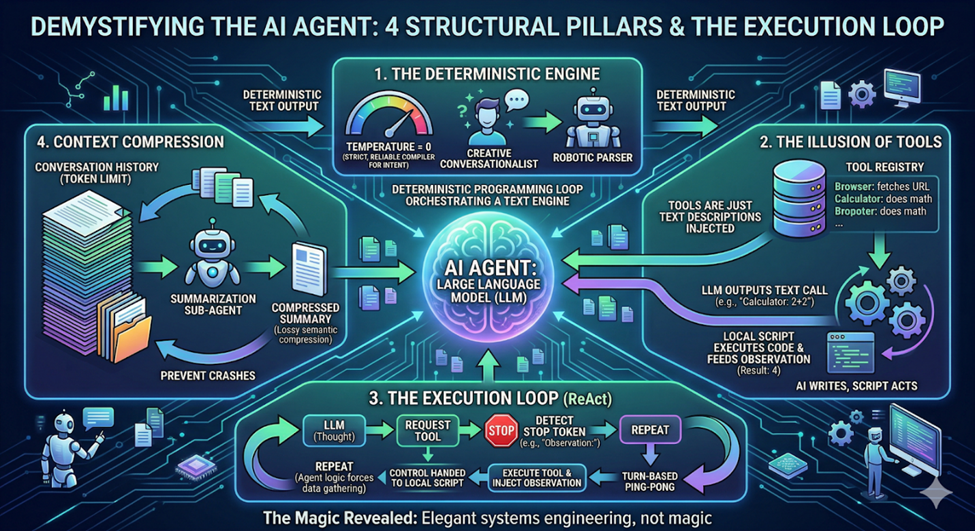
Fundamentally, an autonomous agent relies on four structural pillars as follows:
#1: The deterministic engine: In a standard chat interface, we want AI to be creative and varied. In an agentic system, however, creativity is a liability. An agent needs to repeatedly output precise text syntax to trigger external tools without random variations that could crash the parsing logic. By forcing the underlying large language model (LLM) to operate at a “temperature” of zero, developers eliminate this randomness. The fuzzy, creative conversationalist is transformed into a strict, reliable compiler for intent.
#2: The illusion of tools: How does an LLM know it can use tools like a web browser or a calculator? Surprisingly, the AI doesn’t execute code natively. Tools are merely standard programming functions bundled with simple text descriptions that are injected directly into the LLM’s system prompt. The model simply reads that a “calculator” is available. When it decides to do math, it generates the word “calculator.” A local script catches that text, executes the actual math function, and pastes the result back into the prompt. The AI’s “capabilities” are just an illusion maintained by clever string matching.
#3: The execution loop: By default, an LLM acts as a completion engine that tries to guess a final answer instantly. To create autonomy, developers must force the model to pause, think, and gather real data using a ReAct (Reason and Act) loop. The secret weapon here is a programmatic “stop token.” The system instructs the LLM to explain its logic and request a tool, but forcibly halts the AI the moment it tries to fake the tool’s output. Control is handed back to the local script, which runs the tool and feeds real-world observations back to the model. It becomes an infinite, turn-based game of ping-pong.
#4: Context compression: LLMs are entirely stateless; every single request must include the entire conversation history. Because models have strict token limits, a long-running agent will quickly bloat its prompt and crash. The solution isn’t a massive database, but “lossy compression.” When a conversation grows too long, the system groups the oldest messages, spins up a separate sub-agent to summarize them, and replaces the bulky history with a compact paragraph. Agent memory is nothing more than continuous semantic compression.
The magic revealed
An autonomous AI agent is ultimately a basic while() loop that orchestrates a text engine. It uses text parsing to trigger local code, coupled with summarization to simulate long-term memory. Once you understand these bare-metal patterns, the mystery disappears, replaced by the clarity of elegant systems engineering.
For more “AI from first principles”, please feel free to follow my “Hyperscale” Substack.
shashankbl.substack.com