Reliability is a critical consideration for components used in aerospace applications. A single component failure can have catastrophic consequences, making it essential to use parts that have undergone rigorous qualification and testing to ensure consistent performance, long-term reliability, and extended operational life. This is particularly important for the circuitry that regulates power systems. Failures within these systems can result in the loss of critical functionality, potentially jeopardizing multimillion-dollar assets and, more importantly, human lives.
Historically, aerospace contractors have relied on components manufactured to meet established high-reliability standards developed by government organizations. Among the most widely recognized are the specifications established by the Defense Logistics Agency (DLA), whose military standards are generally regarded as the benchmark for quality and reliability in aerospace and defense applications. For multilayer ceramic capacitors (MLCCs), the primary performance specifications include MIL-PRF-55681 and MIL-PRF-123 for surface-mount devices, as well as MIL-PRF-49470 for leaded devices.
While these specifications have provided dependable performance for decades, they also impose certain limitations. One of the primary constraints stems from the requirement that capacitors be manufactured using precious-metal electrode (PME) technology rather than the base-metal electrode (BME) technology commonly used in commercial-grade ceramic capacitors.
The first limitation is capacitance-to-volume ratio (CV). PME technology requires thicker dielectric layers, which increases the overall size of the capacitor, particularly at higher capacitance values. This effectively limits the maximum capacitance that can be achieved within a given package size, as component thickness can only be increased to a practical extent.
Similarly, PME technology presents challenges to miniaturization. As aerospace systems continue to demand smaller, lighter, and more efficient designs, the components used within them must also shrink. However, because PME capacitors have a minimum dielectric thickness requirement, there are practical limits to how small these devices can be manufactured without sacrificing electrical performance or reliability.
Another disadvantage is the lack of RoHS compliance. Although the impact of this limitation is somewhat mitigated in aerospace applications, where tin-lead (Sn/Pb) solder is often preferred to reduce the risk of tin whisker formation, environmental compliance remains an important consideration in certain markets and programs.
Finally, cost is a significant factor. The use of precious metals substantially increases the manufacturing cost of PME capacitors when compared with BME capacitors, which utilize nickel-based electrodes. As a result, PME devices generally command a premium price while offering fewer advantages in terms of size, capacitance density, and manufacturing efficiency.
With these limitations in mind, KYOCERA AVX embarked on the development and qualification of new BME capacitor designs capable of meeting the stringent reliability requirements of aerospace applications. By offering smaller case sizes with higher CV ratios, these devices enable more compact designs while delivering increased capacitance within the same board area.
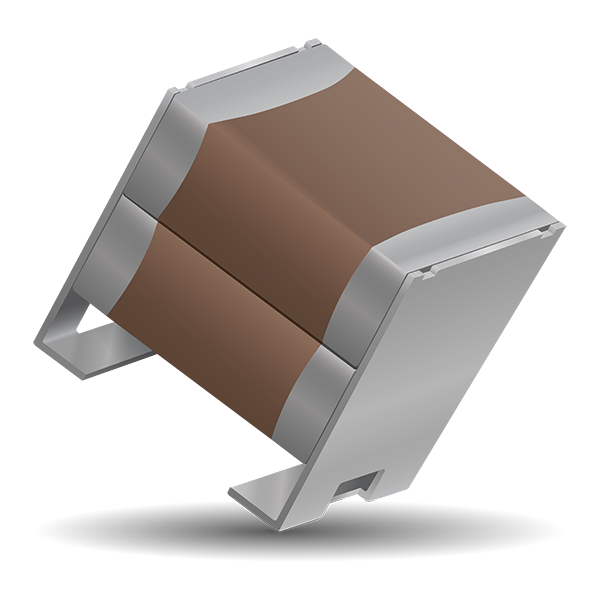
Power systems require effective filtering to prevent noise generated by power conversion stages from interfering with sensitive system signals. This filtering network is typically composed of capacitors spanning a wide range of capacitance values, including bulk capacitors with very high capacitance. KYOCERA AVX’s DSCC 25007 high-reliability stacked capacitor series was specifically developed to address this requirement.
Built on the same proven BME technology utilized in KYOCERA AVX’s MIL-PRF-32535 capacitor family, the DSCC 25007 Mini BME Stacks expands the available solutions for high-reliability power system designers. The lightweight, compact stacked architecture provides high capacitance and voltage capability while minimizing both board space and weight. These capacitors are particularly well suited for applications including DC-DC converter inputs, point-of-load regulators, FPGA power rails, and high-performance processor power distribution networks.
Equivalent Series Resistance (ESR) is widely recognized as a critical parameter in power-supply filtering performance. The multilayer ceramic construction of the DSCC 25007 series results in ESR values that are significantly lower than those of conventional bulk capacitors. This enables the capacitors to effectively absorb high-frequency switching currents, reducing voltage ripple and improving overall power integrity. In addition, the stacked ceramic architecture minimizes Equivalent Series Inductance (ESL), maintaining low impedance at the high frequencies where switching regulators generate the most noise.
Input capacitors used in buck converters and other switch-mode power supplies are subjected to substantial RMS ripple currents. To perform effectively, these capacitors must handle ripple current without excessive self-heating, maintain capacitance under operating conditions, and minimize ESR-related temperature rise. Ceramic capacitor technologies are well known for their superior ripple-current handling capabilities when compared to many electrolytic alternatives. The stacked construction of the DSCC 25007 series further increases electrode area and current-carrying capability, making these capacitors particularly effective in applications where large RMS currents are present at the power entry stage.
Power-input filtering also requires sufficient bulk capacitance to reduce bus ripple, support load transients, and stabilize input voltage during switching events. The stacked BME architecture enables significantly higher capacitance values than a standard single MLCC footprint while retaining the inherent advantages of ceramic technology. Available in capacitance values from 8.2 µF to 220 µF, these devices offer a range comparable to that of MIL-PRF-49470 stacked capacitors while providing a smaller footprint and significantly higher capacitance than conventional surface-mount devices. As a result, the DSCC 25007 series can often replace multiple parallel MLCCs, helping designers reduce board space requirements and simplify overall circuit layout.
In many commercial power systems, aluminum electrolytic capacitors are commonly used for bulk filtering. Aerospace and other high-reliability applications, however, demand performance and longevity beyond what traditional electrolytics can typically provide. Unlike aluminum electrolytics, ceramic capacitors contain no liquid electrolyte, eliminating concerns about electrolyte dry-out and long-term degradation. They also exhibit superior resilience to temperature cycling, contributing to longer operational life and improved long-term reliability.
The DSCC 25007 parts have an initial range of 10 µF at 100V to 47 µF at 25V. The current catalog consists of 2-chip horizontal configurations but will, once approved, expand to 3-chip horizontal and 3- to 10-chip vertical configurations. Lead frames offer enhanced resistance to mechanical stress and have multiple options to help fit any board. The parts’ reliability is confirmed with 100% voltage conditioning and MIL-PRF-32535 Group A testing, with the option for Group B if the customer desires.
KYOCERA AVX’s DSCC 25007 Mini BME stacked capacitors are an attractive solution for power-input filtering because they combine the electrical performance of multilayer ceramic capacitors with substantially higher capacitance and ripple-current capability in a compact, lightweight package. By providing a low-impedance path for AC ripple currents, reducing conducted EMI, and supporting transient load demands, these capacitors address the key requirements of modern power-distribution systems. Their combination of high capacitance density, low ESR, low ESL, excellent ripple-current handling, and aerospace-grade reliability makes them an ideal choice for demanding power-filtering applications.
www.kyocera-avx.com