Modern aerospace and defense systems are becoming increasingly autonomous, software-defined, and driven by advances in artificial intelligence. From autonomous aircraft and precision-guided systems to advanced surveillance platforms, modern systems rely on sophisticated software to process sensor data, make real-time decisions, and coordinate increasingly complex missions. Regardless of how intelligent these systems become, every digital command must ultimately be translated into physical action. Flight control surfaces must move, radar antennas must steer, electro-optical systems need to be stable, sonar transducers must transmit, and precision actuators must respond. All of these depend on high-performance analog components to bridge the gap between the digital and the physical world.
While software determines what a system should do, analog power electronics determine how those commands are executed. Low-power digital signals generated by processors must be converted into precisely controlled voltage and current capable of driving motors, piezoelectric actuators, magnetic coils, valves, and other electromechanical devices. Whether controlling a flight surface, stabilizing an electro-optical payload, or steering a radar antenna, the performance of these analog power stages directly influences system accuracy, responsiveness, and reliability. In many cases, they are just as critical to mission success as the processors and software that generate the original commands.
Designing these systems for aerospace and defense applications presents a unique set of engineering challenges. Unlike commercial electronics, mission-critical platforms must continue operating after prolonged storage, rapid temperature transitions, continuous vibration, mechanical shock, and exposure to electrically noisy environments. Spaceborne electronics introduce the additional challenge of ionizing radiation, while aircraft and missile systems must maintain precision despite high acceleration and rapidly changing operating conditions. Meeting these requirements demands analog power electronics that balance high voltage, high current, bandwidth, efficiency, and long-term reliability while operating within increasingly compact and power-constrained designs.
Engineering for Extreme Environments
The demands placed on analog power electronics continue to grow as aerospace platforms become more compact, while demanding higher capabilities. Designers must increase performance while reducing size, weight, and power consumption (SWaP) without compromising reliability. At the same time, higher-resolution sensors, faster control loops, and advanced electro-optical payloads require amplifiers capable of delivering greater bandwidth, faster slew rates, and increasingly precise current control.
Meeting these requirements often involves carefully balancing multiple performance characteristics. High operating voltages enable the control of demanding loads such as piezoelectric actuators and magnetic deflection systems, while high output current is necessary for driving servo motors, electromechanical actuators, and sonar transducers. Wide power bandwidth and fast slew rates allow systems to respond rapidly to changing inputs without sacrificing stability, while low distortion and accurate current regulation help maintain pointing accuracy, positioning precision, and overall control performance.
Reliability remains equally important. Military and aerospace electronics frequently operate across extended temperature ranges while enduring continuous vibration, mechanical shock, and electrically noisy environments. In many applications, maintenance or replacement is impossible once a system is deployed, making long-term stability and predictable performance just as important as peak electrical specifications.
Precision Control Through Closed-Loop Systems
In many aerospace and defense applications, generating motion is only part of the challenge. Aircraft flight controls, electro-optical gimbals, radar positioning systems, and precision actuators all operate within closed-loop control systems that continuously monitor position, velocity, or force and make real-time corrections. These feedback loops enable platforms to maintain stability, compensate for disturbances, and achieve the level of precision required for mission-critical operation.
Within these systems, analog power amplifiers serve as the critical interface between digital control algorithms and physical movement. The amplifier must accurately reproduce the controller’s output while supplying sufficient voltage and current to drive the load without introducing distortion or instability. As control systems become faster and more sophisticated, amplifier characteristics such as bandwidth, slew rate, settling time, and current regulation play an increasingly important role in overall system performance. The result is smoother motion, improved positioning accuracy, and greater confidence that critical systems will respond exactly as intended.
Guidance and Flight Control
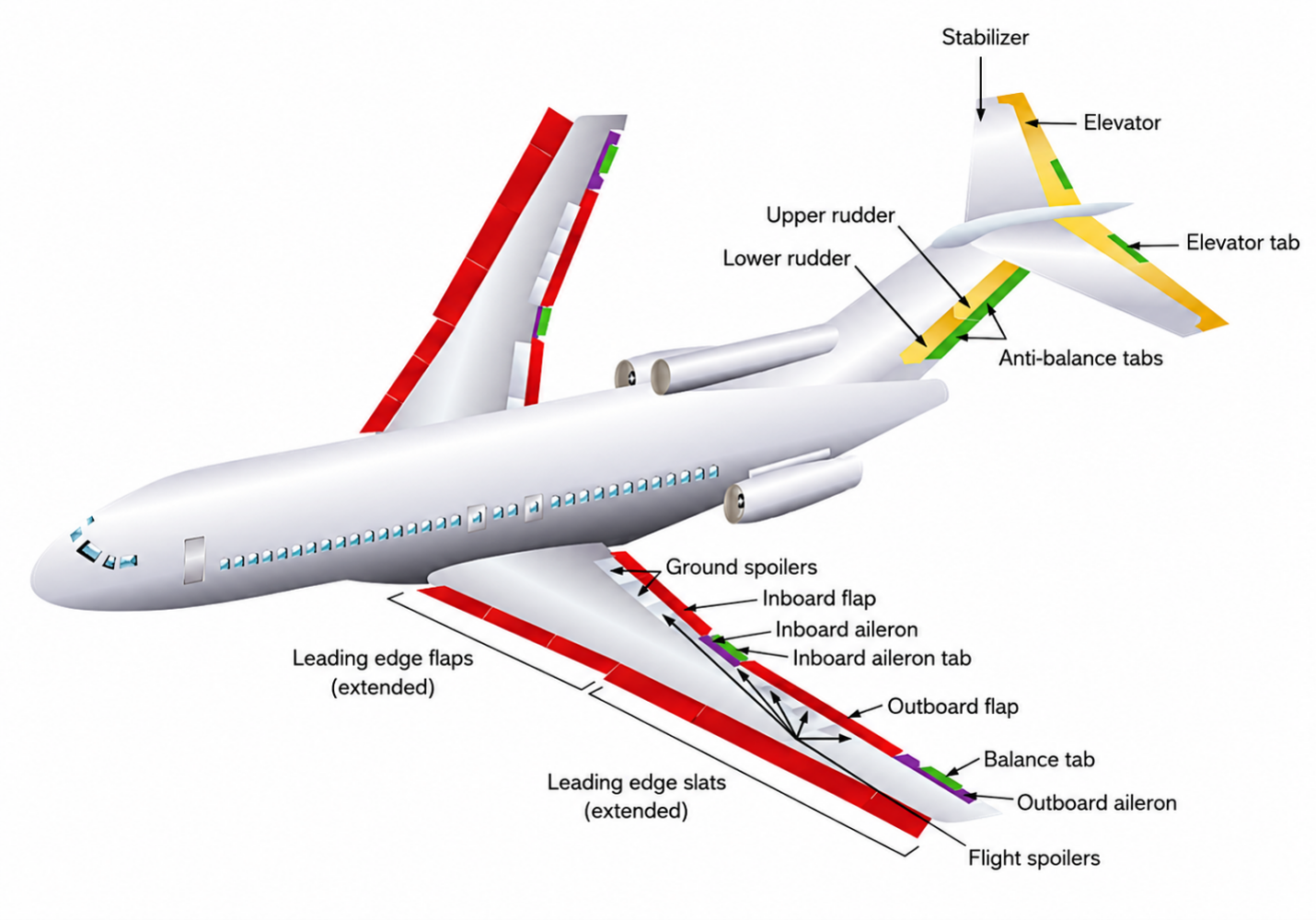
Few systems demonstrate the importance of analog power electronics more clearly than modern flight controls like those shown in Figure 2. Whether commanding an aircraft’s ailerons, elevators, rudders, or flaps, today’s flight computers continuously calculate precise control corrections based on pilot input and sensor feedback. These calculations, however, produce only low-power electrical signals. Before any control surface can move, those commands must be amplified into precisely regulated currents capable of driving high-performance electric motors or electro-hydraulic actuators.
Maintaining stable flight depends on far more than simply generating enough power. Motor-drive electronics must deliver smooth acceleration, accurate positioning, rapid response, and consistent performance across changing temperatures and aerodynamic loads. Small errors in current regulation or control-loop stability can translate directly into reduced positioning accuracy or unwanted oscillation. As aircraft continue transitioning toward Power-by-Wire architectures, where traditional centralized hydraulic systems are increasingly replaced by electrically actuated control surfaces, the demands placed on these analog power stages continue to increase.
Electro-Optical Systems
Modern defense platforms rely heavily on electro-optical systems for surveillance, target acquisition, navigation, and laser-based sensing. Whether mounted on aircraft, naval vessels, ground vehicles, or satellites, these systems must maintain precise pointing accuracy while compensating for vibration, vehicle movement, and environmental disturbances.
Achieving this level of stability requires carefully controlled multi-axis gimbals driven by high-performance servo systems. Rather than prioritizing maximum motor speed, these applications emphasize smooth current delivery, low noise, and exceptional position repeatability. Even minute disturbances can degrade image quality, reduce tracking accuracy, or introduce pointing errors into laser designators and range-finding systems. Analog power amplifiers therefore play a central role in maintaining stable motion, providing the precise current regulation needed to position sensors with sub-degree accuracy.
Adaptive Optics Push Analog Performance Even Further
Not every precision motion system relies on conventional motors. Many advanced optical systems instead employ piezoelectric actuators capable of moving mirrors by only a few microns while responding thousands of times per second. These devices are widely used in adaptive optics, laser beam steering, optical communications, and astronomical imaging, where correcting even the smallest distortion can dramatically improve system performance.
Driving piezoelectric actuators presents a unique challenge because they behave primarily as capacitive loads, requiring amplifiers capable of rapidly charging and discharging large capacitances without sacrificing linearity. High output voltage, fast slew rates, and wide bandwidth become essential for maintaining accurate mirror positioning and compensating for rapidly changing optical distortions.
The Future of Analog Power in Aerospace
As aerospace and defense platforms continue evolving, the role of analog power electronics is becoming even more significant. The industry is steadily moving toward more-electric aircraft, autonomous vehicles, and increasingly sophisticated sensor systems, all of which depend on precise control of motors, piezo actuators, and other electromechanical devices. At the same time, engineers are challenged to reduce size, weight, and power consumption while increasing system capability and reliability.
These trends place greater demands on analog power electronics than ever before. Higher-resolution sensors require more stable positioning, advanced electro-optical payloads demand faster response times, and compact platforms leave less room for thermal management and power loss. Whether enabling electrically actuated flight controls, stabilizing imaging systems, or driving next-generation directed energy and communication technologies, analog power amplifiers remain a foundational technology that allows digital intelligence to interact with the physical world.
Proven Analog Solutions for Mission-Critical Applications
For more than four decades, Apex Microtechnology has specialized in developing high-voltage, high-current analog power solutions for demanding industrial, aerospace, and defense applications. As next-generation platforms continue moving toward higher power density, with a reduced footprint, Apex has expanded our portfolio to address these evolving requirements. In addition to its precision linear amplifiers and PWM motor drivers, Apex recently introduced the MSA303, a compact three-phase Silicon Carbide (SiC) Integrated Power Module designed for high-voltage BLDC and PMSM motor drive applications. By integrating three half-bridges, gate drivers, and protection features into a single package, the MSA303 helps engineers reduce system size and complexity while improving efficiency.
Many of these devices are available with MIL-PRF-38534 Class H screening, while radiation-tolerant families support applications requiring testing for Total Ionizing Dose (TID), Single Event Effects (SEE), Enhanced Low Dose Rate Sensitivity (ELDRS), and Particle Impact Noise Detection (PIND). These technologies have supported applications ranging from aircraft flight controls and electro-optical stabilization systems to active sonar, missile guidance, and numerous spaceflight programs, including the International Space Station, the Mars Rover, the James Webb Space Telescope, and OSIRIS-REx.
Rather than developing application-specific solutions for individual programs, Apex’s amplifier portfolio provides design engineers with flexible building blocks capable of addressing a broad range of analog power challenges. Whether driving precision motors, piezoelectric actuators, magnetic coils, or sonar transducers, these devices are designed to deliver the combination of voltage, current, speed, and long-term reliability required in today’s aerospace and defense systems.