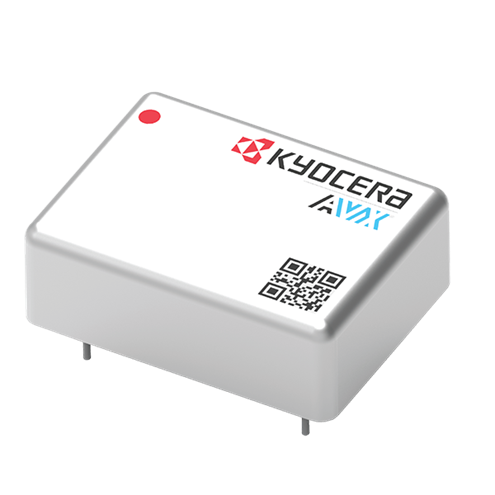
OCXOs significantly surpass the stability of standard XOs and TCXOs
by Ryan Messina, Technical Support Group, Technical AE at KYOCERA AVX Components
In the demanding realm of aerospace, precision is not just a benefit—it’s absolutely critical. From satellite navigation to avionics systems and deep-space communication, every component must perform flawlessly under extreme conditions. The oven-controlled crystal oscillator (OCXO) is a highly reliable timing device. These compact powerhouses offer exceptional frequency stability and accuracy, making them essential in aerospace applications where precise timing can significantly impact the success or failure of a mission.
What’s an OCXO, anyway?
Before we proceed to applications, let us establish a foundational understanding of the essentials. An oven-controlled crystal oscillator is a specialized type of crystal oscillator designed to maintain a stable frequency output by keeping its quartz crystal at a constant temperature. Quartz crystals, as covered in other discussions of timing devices, are piezoelectric marvels that vibrate at a specific frequency when an electric signal is applied. However, their frequency can drift with temperature changes—a significant issue in aerospace, where components face extreme temperature swings from icy high-altitude conditions (–55°C in the stratosphere) to the scorching heat of re-entry or space exposure (up to 125°C or more).
An OCXO addresses this by housing the crystal in a miniature “oven”; that is, a temperature-controlled chamber that maintains a consistent environment, typically between 70°C and 85°C, where the crystal’s frequency remains most stable. The core components of an OCXO include:
• The Quartz Crystal: The frequency-determining element, cut to resonate at a precise frequency.
• The Oscillator Circuit: Amplifies the crystal’s signal to produce a usable output.
• The Oven: A thermally insulated chamber with a heater and temperature sensor to regulate the crystal’s environment.
• The Control Circuit: Monitors and adjusts the oven’s temperature to counteract external variations.
This setup enables OCXOs to achieve frequency stability on the order of parts per billion (ppb), significantly surpassing the stability of standard crystal oscillators (XOs) or temperature-compensated crystal oscillators (TCXOs), which typically offer stability in the parts per million (ppm) range. For aerospace, where precision timing underpins everything from navigation to data transmission, this stability is non-negotiable.
Why OCXOs are aerospace all-stars
Aerospace systems require timing solutions that can withstand extreme environments, such as vibration from rocket launches, radiation in space, and rapid temperature fluctuations. OCXOs shine in these scenarios:
• Satellite Communication: Satellites rely on OCXOs for precise timing in signal transmission and reception. Whether it’s GPS satellites providing navigation data or communication satellites relaying high-speed internet, OCXOs ensure synchronization across vast distances. In GPS systems, for example, timing errors of even a nanosecond can translate to position errors of several meters, making OCXOs critical for sub-meter accuracy.
• Avionics Systems: Modern aircraft utilize fly-by-wire systems, radar, and collision-avoidance technologies, all of which require synchronized clocks. OCXOs provide the stable reference signals needed for real-time data processing in electronic control units (ECUs) and flight management systems.
• Space Exploration: Deep-space missions, like those to Mars or beyond, face extreme temperature and radiation challenges. OCXOs, such as those from KYOCERA AVX’s aerospace-grade series, are designed to maintain performance in these harsh conditions, supporting communication between rovers and Earth or synchronizing scientific instruments.
• Military Applications: In defense aerospace, OCXOs are used in secure communication systems, missile guidance, and unmanned aerial vehicles (UAVs). Their ability to maintain frequency stability under vibration and shock ensures reliable operation during high-G maneuvers.
A standout feature of OCXOs is their low phase noise, which minimizes jitter in high-frequency signals. This is crucial for applications like radar and satellite transponders, where clean signals ensure accurate detection and data integrity. Additionally, OCXOs are designed to meet stringent standards, such as MIL-PRF-55310, ensuring they can withstand the mechanical and thermal stresses of aerospace environments.
Design considerations for OCXOs
While OCXOs are a designer’s dream for precision, they come with trade-offs that require careful consideration. Let’s break down the key factors:
• Power Consumption: The oven in an OCXO requires power to maintain temperature, making them hungrier than standard XOs or TCXOs. In aerospace, where power budgets are tight (especially in satellites or battery-powered UAVs), designers must balance stability with energy efficiency. For example, KYOCERA AVX’s low-power OCXO series optimizes heater design to reduce consumption while maintaining ppb-level stability.
• Size and Weight: Aerospace applications prioritize compact, lightweight components. While OCXOs are larger than TCXOs due to the oven, manufacturers like KYOCERA AVX offer miniature OCXOs that pack high performance into tight spaces, ideal for avionics or CubeSats.
• Warm-Up Time: OCXOs require time to stabilize their oven temperature after power-on, typically a few minutes. For missions requiring instant readiness, designers may pair an OCXO with a TCXO for initial operation, switching to the OCXO once it has warmed up.
• Aging and Longevity: Over time, crystal aging can cause a slight frequency drift. Aerospace-grade OCXOs are designed with high-quality crystals and robust manufacturing processes to minimize aging, ensuring decades of reliable operation—a must for satellites with lifespans of 15 years or more.
• Environmental Robustness: Aerospace OCXOs must comply with standards like AEC-Q200 or MIL-STD-883 for shock, vibration, and radiation resistance. Designers should verify that components, such as those from KYOCERA AVX, are qualified for the specific temperature ranges and mechanical stresses of their intended application.
Practical tips for designers
As a designer, choosing the appropriate OCXO requires aligning its performance with the mission’s needs. Here are some useful tips to help keep your aerospace project on course:
• Prioritize Stability: For applications such as GPS or radar, choose OCXOs with frequency stability better than ±50 ppb over the operating temperature range. KYOCERA AVX’s aerospace OCXOs, for example, offer ±10 ppb stability, making them ideal for critical systems.
• Consider Power Trade-offs: If power is a constraint, explore low-power OCXOs or hybrid solutions that combine TCXOs for low-power modes. Evaluate the mission profile to determine if warm-up time impacts performance.
• Match Form Factor: For space-constrained designs, opt for compact OCXOs with surface-mount (SMD) packages. Radial or through-hole options are better suited for high-vibration environments, such as those found in rocket payloads.
• Test for Harsh Conditions: Utilize OCXOs certified to aerospace standards and simulate real-world conditions (e.g., thermal cycling, vibration) during prototyping to ensure reliability.
• Leverage Manufacturer Support: Companies like KYOCERA AVX provide detailed datasheets and application notes for aerospace OCXOs. Tap into their expertise to fine-tune your design for specific frequency, phase noise, or environmental needs.
The Future of OCXOs in Aerospace
As aerospace pushes boundaries—think lunar bases, hypersonic aircraft, or mega-constellation satellites—OCXOs will continue to evolve. Emerging trends include lower-power designs for small satellites, enhanced radiation hardening for deep-space missions, and integration with atomic clocks for next-generation navigation systems.
To conclude, oven-controlled crystal oscillators are essential for aerospace timing, providing the accuracy and dependability necessary for mission-critical systems. Their ability to sustain stable frequencies in harsh conditions makes them vital for satellites, avionics, and other applications. Designers should consider power, size, and environmental conditions while working with trusted suppliers like KYOCERA AVX to ensure their systems stay on schedule every time. In a field where every second matters, OCXOs help aerospace reach new heights.