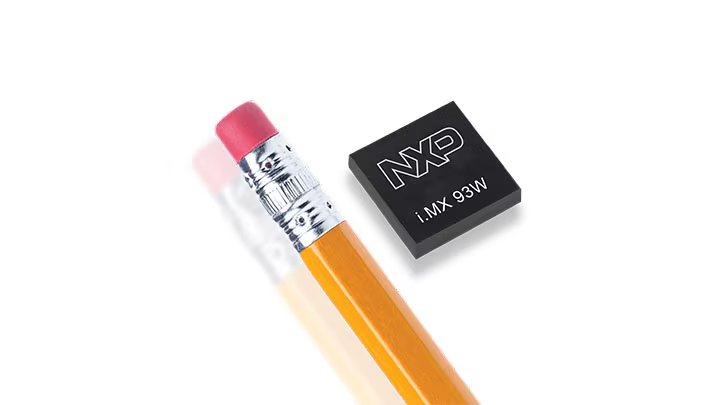
Anyone building connected edge products knows how challenging packaging components and ensuring everything works as intended can be. A Wi-Fi front-end, Bluetooth Low Energy (BLE) coexistence, and 802.15.4 radio if you want Matter or Thread all add complexity. There are passive components such as resistors, capacitors and crystals to consider, and regional RF layout certifications to pass before shipping. This is in addition to integrating the SOC whose functions are at the heart of the design. By the time you’re done, your edge AI board is half AI silicon and half RF plumbing.
Physical AI systems impose multiple requirements on the hardware platform simultaneously. They need enough compute to run inference and agents locally, but they also need deterministic control, robust connectivity, compact design, low power consumption, and strong security. They need to support multiple wireless standards, operate reliably, and avoid adding certification burdens that slow time-to-market.
These are the problems the i.MX 93W has been built to solve.
What’s in the package:
The i.MX 93W is a system-in-package that fuses NXP’s i.MX 93 applications processor with the IW610 tri-radio and the full radio BOM—passives, crystal, RF front-end—into a single device. This means it replaces up to 60 discrete components.
On the compute side, it has dual Arm Cortex-A55 cores for Linux and the main application stack, a Cortex-M33 for real-time control and low-power tasks, and an Arm Ethos NPU for accelerating local AI workloads such as detection, classification, and sensor analysis. Connectivity includes Wi-Fi 6, Bluetooth Low Energy, and 802.15.4 for Matter and Thread designs. It also has an EdgeLock Secure Enclave for hardware-based security functions, including root of trust, secure boot, attestation, and key management.
Why the A55 + M33 + NPU split matters
If you’ve designed anything that has to both think and react, you know “AI capable” alone isn’t enough. The A55 cluster is the workhorse, running Linux and carrying the application workload. The NPU sits alongside to accelerate inference. The M33 keeps deterministic control loops alive while the Linux side is doing whatever Linux does. That partitioning is what makes the i.MX 93W usable in real products—HVAC controllers, predictive maintenance nodes, patient monitors—where you can’t miss a deadline because the kernel scheduler had opinions.
1.8 eTOPS isn’t going to run a vision transformer at full video frame rate, and it isn’t trying to. It’s sized for the workloads these systems need: keyword spotting, anomaly detection, light vision (presence, counting, classification), sensor fusion, and small agent models running locally.
The certification story
For engineers, one of the most exciting aspects is that the i.MX 93W ships with pre-certified reference designs. RF certification is where edge AI projects die. The schedule slips, the test house finds a spur you didn’t expect, you re-spin the board… Pre-certified RF cuts a real chunk of that risk. And with the EU Cyber Resilience Act landing on every connected device over the next couple of years, having the EdgeLock Secure Enclave already in the SoC is one less thing to architect from scratch.
The bigger point
Edge AI scales when the hardware is no longer the bottleneck. That means fewer parts, smaller boards, wireless connectivity that doesn’t become a certification project of its own, and security designed into the platform from the start rather than added later. For physical AI products, the i.MX 93W is about making the whole system easier to build, certify, and ship.
By Kyle Fox, NXP Semiconductors
www.nxp.com